Sunday, September 25, 2016

failure to capture: pacemaker


Tx: repair/replace pacemaker

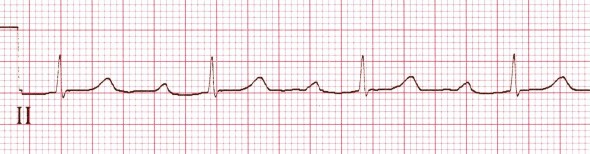
1st degree AV block


Tx:
Figure out H's & T's
Be prepared to use external pacer


Mechanism:
First-degree atrioventricular (AV) block, or first-degree heart block, is defined as prolongation of the PR interval on an electrocardiogram (ECG) to more than 200 msec.[1] The PR interval of the surface ECG is measured from the onset of atrial depolarization (P wave) to the beginning of ventricular depolarization (QRS complex). Normally, this interval should be between 120 and 200 msec in the adult population. First-degree AV block is considered “marked” when the PR interval exceeds 300 msec.[2]
Whereas conduction is slowed, there are no missed beats. In first-degree AV block, every atrial impulse is transmitted to the ventricles, resulting in a regular ventricular rate.


See more/Sources:
http://emedicine.medscape.com/article/161829-overview

sinus tachycardia

Tx: figure out causes ex. Hypoxia, hypovolemia, fever, anxiety etc.

Rate: 13 QRS x 10 = 130 (assumed this is a 6-sec strip) or see 2 boxes between 2 QRS = about 150 bpm

Rhythm:
P - P before each QRS
QRS - QRS is after each Q
Regularity - Every beat is overall the same

Axis - skip this for now

Width:
PR interval - 3ss (normal) and is fixed in every beat
Q - 1ss (<0.11sec) - normal
RR: QT segment < 1/2 RR 

Height:
P wave upright in lead II (assumed lead II for every 6sec strip)
No ST elevation

=> This is a normal sinus tachycardia NSR tachy! 


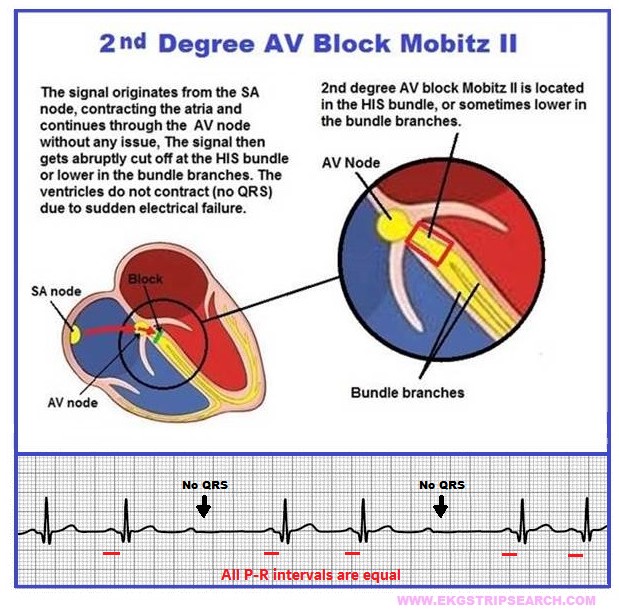
2nd degree AV block with Mobitz II


Tx:

 watchful waiting,
 figure out causes,
 pacemaker, 
atropine can be tried if rhythm isn’t due to ischemia (i.e. MI).  Atropine, when the heart is ischemic, can cause ventricular tachycardia!

A-fib


Tx:
- Anticoagulation, 
- synchronized cardioversion (if appropriate), 
- beta blockers to control heart rate

agonal rhythm going to asystole


Tx:
CPR, 
epinephrine, 
IV fluids, 
intubate, 
oxygen

PAC

Tx: none